


Common Knowledge is dedicated to reinventing documents – the surfaces we use to read, write, and create – in the age of machine intelligence.
A brief history of the document
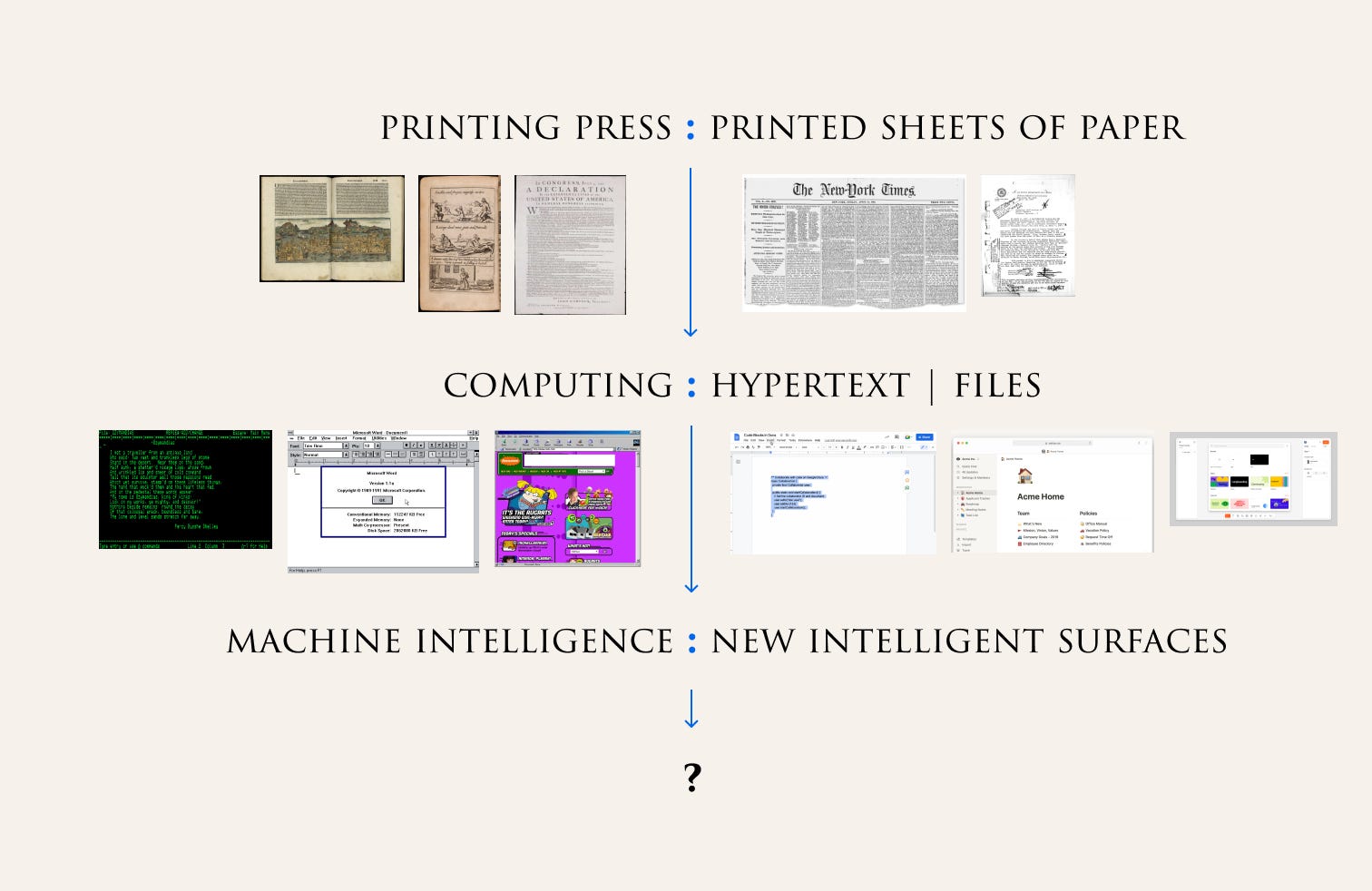
Written language and the printing press gave us the format we associate with documents: printed sheets of paper. Entire disciplines – bookbinding, typesetting, illustration – developed out of a need to convey information clearly with this new medium.
Computers then made those pages more powerful, giving us hypertext, spreadsheets, websites, graphical user interfaces, and collaborative multimedia editing tools. These new documents broadened both the volume and variety of human creative work and formed the face of what we think of as a classical operating system today.
Now, Machine Intelligence gives us a new material – one whose inherent malleability allows us to invent entirely new surfaces. These new interfaces might look as alien to us today as a MySpace page might have looked to Shakespeare. How will they allow us to read, write, and create in new ways?
We’ll be sharing some new experiments in the coming weeks and months. Come join us for the journey.
Find us at @cmmnknwledge and commonknowled.ge